
You have no items in your shopping cart.


Niacinamide for Rosacea:A Gentler Routine for Sensitive Skin
Rosacea is one of the most reactive conditions in skincare. The wrong ingredient at the wrong concentration can trigger a flare-up that takes weeks to settle.
The right ingredients, in the right delivery, can do the opposite. Encapsulated niacinamide calms redness and supports the barrier without the irritation that conventional actives often cause.
This is the foundation of the Rejuvaus rosacea routine, and the reason we deliberately leave retinaldehyde out of it.
WHAT ROSACEA IS,
AND WHAT MAKES IT HARDER TO TREAT
Rosacea is a chronic skin condition that affects the central face. It appears as persistent redness, flushing, visible capillaries, and in some cases small inflammatory bumps. Researchers group it into four subtypes: erythematotelangiectatic (redness and visible vessels), papulopustular (redness with breakouts), phymatous (thickened skin, usually on the nose), and ocular (involving the eyes). Most people with rosacea sit in the first two categories.
What makes rosacea harder to treat than most skin conditions is the state of the barrier underneath. Rosacea-prone skin has higher transepidermal water loss, lower ceramide content and an oversensitive immune response. This is why so many actives that work well on stable skin trigger flare-ups in rosacea. The barrier has to come first. Everything else builds on top of it.

WHY RETINALDEHYDE IS NOT IN THE DEFAULT REJUVAUS ROSACEA ROUTINE
Most rosacea content treats vitamin A as a binary: avoid retinol. The reality is more nuanced. Encapsulated retinaldehyde is well-tolerated on stable skin, including skin that historically reacted to conventional retinol. The slow-release delivery keeps the active away from the inflammatory pathway that triggers flare-ups.
But for active rosacea, the priority is barrier repair first. Adding vitamin B3 to skin in flare adds work to a barrier that is already struggling.
The Rejuvaus default rosacea routine deliberately leaves retinaldehyde out and leads with encapsulated niacinamide and growth factor, which calm and rebuild without provoking. Once the skin is stable and the barrier is healthy, encapsulated retinaldehyde can be introduced gradually, often through the Bright & Correct Niacinamide Serum used on alternating nights.
tHE REJUVAUS ROSACEA ROUTINE
The default routine is four steps. Two minutes morning, two minutes night.
Cleanse

Start with the Gentle Exfoliating AHA Cleanser, which uses lactic acid at a low concentration to support cell renewal without disrupting the barrier. For acutely reactive or post-procedure skin, switch to the Calming Cream Aloe Cleanser, which contains no acids and prioritises soothing over exfoliation.
Treat

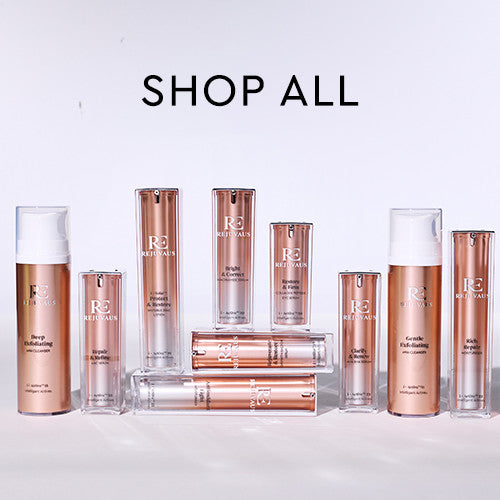
Take one pump of Bright & Correct Niacinamide Serum.
The niacinamide calms and strengthens the barrier.
Treat

One pump of Rejuvenate & Restore Growth Factor Serum, blend them in your palm, and press into damp skin across face and neck.
The growth factor supports cell repair and elasticity. Together, in one blended layer.
Protect (AM only)

Finish with the i Solar Protect & Restore Invisible Zinc Lotion. 16% non-nano zinc oxide and 5% titanium dioxide provide broad-spectrum mineral protection without irritation.
UV is one of the strongest rosacea triggers, so this step is non-negotiable in the morning.
That is the full routine. No layering of multiple serums.
No skin-cycling complexity. Two minutes, twice daily.
HOW ENCAPSULATED NIACINAMIDE CALMS ROSACEA-PRONE SKIN
Niacinamide itself is not unusual in rosacea-targeted skincare. What is unusual is the delivery. Conventional niacinamide serums release the active in a single dose at the skin surface.
For rosacea-prone skin, this can be enough to provoke a histamine response, even at moderate concentrations.
The Bright & Correct Niacinamide Serum uses 10% encapsulated niacinamide. The encapsulation releases the active in stages over eight to twelve hours, well below the threshold that triggers flushing in most users. The same concentration that would normally feel too strong becomes well-tolerated. The result is calmer skin, stronger barrier, fewer flare-ups, all without the trade-off most rosacea sufferers have learned to expect from active skincare.

CUSTOMER RESULTS
In a customer satisfaction survey of users with sensitive and rosacea-prone skin using the Bright & Correct Niacinamide Serum twice daily:
Saw visible improvements in skin clarity within two weeks
Reported overall satisfaction with the routine
n=133 · Two-week minimum use · Twice-daily application

WHAT TO AVOID IF YOU HAVE ROSACEA
The shortlist of ingredients to avoid in active rosacea:
- Alcohol denat in toners and serums dehydrates and inflames
- Fragrance (including essential oils) is one of the most common trigger ingredients
- High-concentration alpha hydroxy acids like glycolic and mandelic at 5% or above
- Conventional retinol without encapsulated slow-release
- Witch hazel, peppermint and eucalyptus, all common in natural formulations
- SLS and SLES sulfates in foaming cleansers
- Physical scrubs with abrasive particles

The general rule: if a product tingles, prickles or warms the skin on application, stop using it. Rosacea-prone skin does not benefit from active sensations the way stable skin sometimes does. Calm should feel like nothing at all.
WHEN TO SEE A DOCTOR
Skincare manages mild to moderate rosacea well. Moderate to severe rosacea needs a GP or dermatologist.
Signs that prescription treatment may be appropriate include:
- Persistent inflammatory bumps that do not settle with topical care
- Visible thickening of the skin, usually around the nose
- Eye involvement (gritty sensation, dryness, redness in the eye area)
- Flare-ups that last weeks rather than days
Common medical treatments include topical metronidazole, topical ivermectin, oral doxycycline and laser for visible vessels. The Rejuvaus rosacea routine is safe to use alongside most of these. Check with the prescribing doctor first.
Dr Garry Cussell and the team at Rejuvenation Clinics of Australia treat rosacea daily in clinic and developed the Rejuvaus skincare protocol from that clinical experience.